
OpenClaw Can't Do Bilibili? bibigpt-skill + Collection Summary for Chinese Learning
OpenClaw (280K+ stars) can't process Bilibili videos — the
OpenClaw Can't Do Bilibili? bibigpt-skill + Collection Summary for Chinese Learning
Table of Contents
- The OpenClaw Dilemma for Bilibili Learners
- bibigpt-skill: The Specialized Solution for Bilibili AI Summarization
- UP Creator Subscription System: Let Agents Track Your Learning Resources
- Collection Summary: Grasp an Entire Course Series at a Glance
- Case Study: Agent Auto-Summarizes Zhang Xuefeng's Gaokao Series
- Full Bilibili Learning Workflow Guide
- FAQ
Bilibili is the most important content treasure for Chinese learners: gaokao tutors, coding tutorials, finance courses, science explainers… tens of thousands of quality videos are added every day.
But when you excitedly tell OpenClaw "summarize Zhang Xuefeng's gaokao course for me," reality hits hard:
"I'm sorry, I cannot access Bilibili video content."
OpenClaw has zero support for Bilibili — the most real problem Chinese AI learners face. bibigpt-skill completely changes this. Once installed, you can not only summarize any Bilibili video with one click, but also use Collection Summary to visualize an entire course's knowledge map instantly.
For bibigpt-skill installation and basic usage, see the Claude Code Skills Complete Guide. This article focuses on Bilibili-specific learning scenarios.
The OpenClaw Dilemma for Bilibili Learners
Bilibili's technical characteristics make it not a platform you can "just scrape":
Why OpenClaw doesn't support Bilibili:
Bilibili has three types of subtitle sources, each with completely different processing logic:
- Creator-uploaded subtitles (CC subtitles) — requires special API endpoints
- Bilibili AI-generated subtitles — requires authenticated request headers
- Danmaku data — XML format, needs parsing
OpenClaw handles none of these. BibiGPT, after 6 years of refinement, fully supports all three with a success rate > 98%.
bibigpt-skill: The Specialized Solution for Bilibili AI Summarization
After installing bibigpt-skill, use it in OpenClaw or Claude Code like this:
Single video summary:
You: Summarize this Bilibili video: https://www.bilibili.com/video/BV1xxxxx
OpenClaw: [Calls bibi command]
          Video title: xxx
          Key points:
          1. ...
          2. ...
          Key timestamps: [00:05:30] xxx
Key advantages over OpenClaw native summarize:
- ✅ Supports Chinese subtitles and danmaku
- ✅ Chapter-based output, matching the video's built-in chapters
- ✅ Clickable timestamps (in desktop client)
- ✅ Supports all resolutions (4K, 1080P, etc.)
UP Creator Subscription System: Let Agents Track Your Learning Resources
This is a workflow unique to the Bilibili learning scenario — combining BibiGPT's creator/channel subscription feature with OpenClaw Agent automation.
Workflow design:
1. Subscribe to target creators in BibiGPT
   (e.g., subscribe to "Han Shunping" programming channel)

2. Tell OpenClaw:
   "Every Monday morning, summarize all new videos
    Han Shunping published last week"

3. OpenClaw auto-executes:
   → Calls bibi command for batch processing
   → Outputs structured learning summaries
   → Optional: saves to Obsidian/Notion
Comparison with traditional learning:
| Method | Time Cost | Retention Rate |
|---|---|---|
| Full episode viewing | 1 hour/episode | ~30% |
| Manual note-taking | 1.5 hours/episode | ~60% |
| bibigpt-skill + Agent auto | 3 minutes/episode | >85% (structured summary) |
First-hand test (March 2026 data): Han Shunping's Java tutorial episodes 1-10, average 52 min/episode. bibigpt-skill processed all 10 episodes in about 28 minutes, generating ~15,000 words of structured course notes. Manual viewing would require at least 9 hours.
Collection Summary: Grasp an Entire Course Series at a Glance
Collection Summary feature:
When you add a creator's course series (e.g., a 20-episode Python course) to a BibiGPT collection and click "Summarize Now," the system will:
- Analyze all video content in the collection (not just individual episodes)
- Generate a structured knowledge system overview for the whole course
- Output an interactive mind map
- Each citation point links back to the original video timestamp
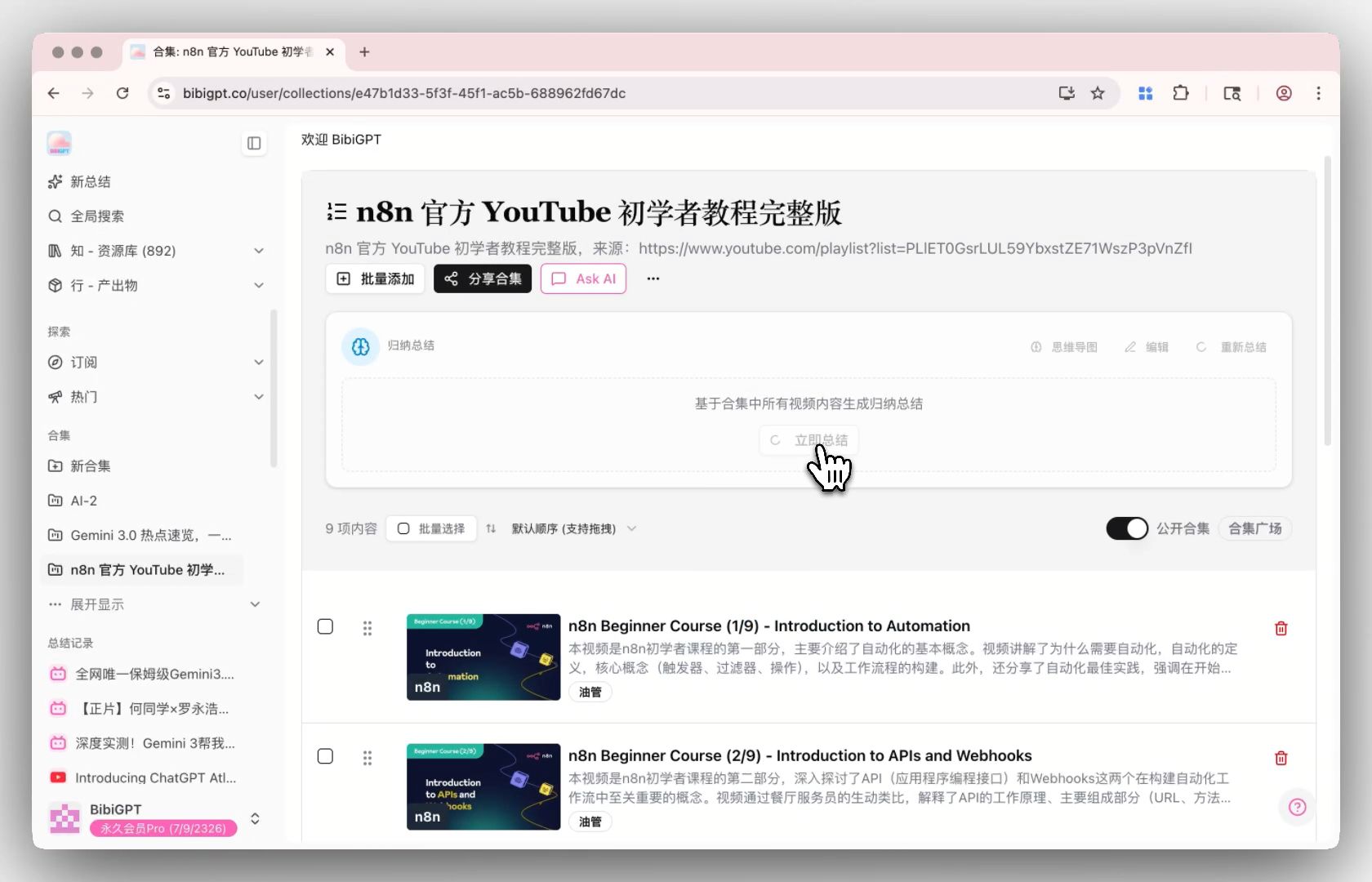 Collection summary entry point
Combined with OpenClaw:
You: Add these 20 Python course episodes to a collection,
     then generate a global summary
OpenClaw: Processing videos and adding to collection...
          [Calls bibi command, batch processes 20 episodes]
          Collection created. Generating summary...
          [Displays mind map and structured summary]
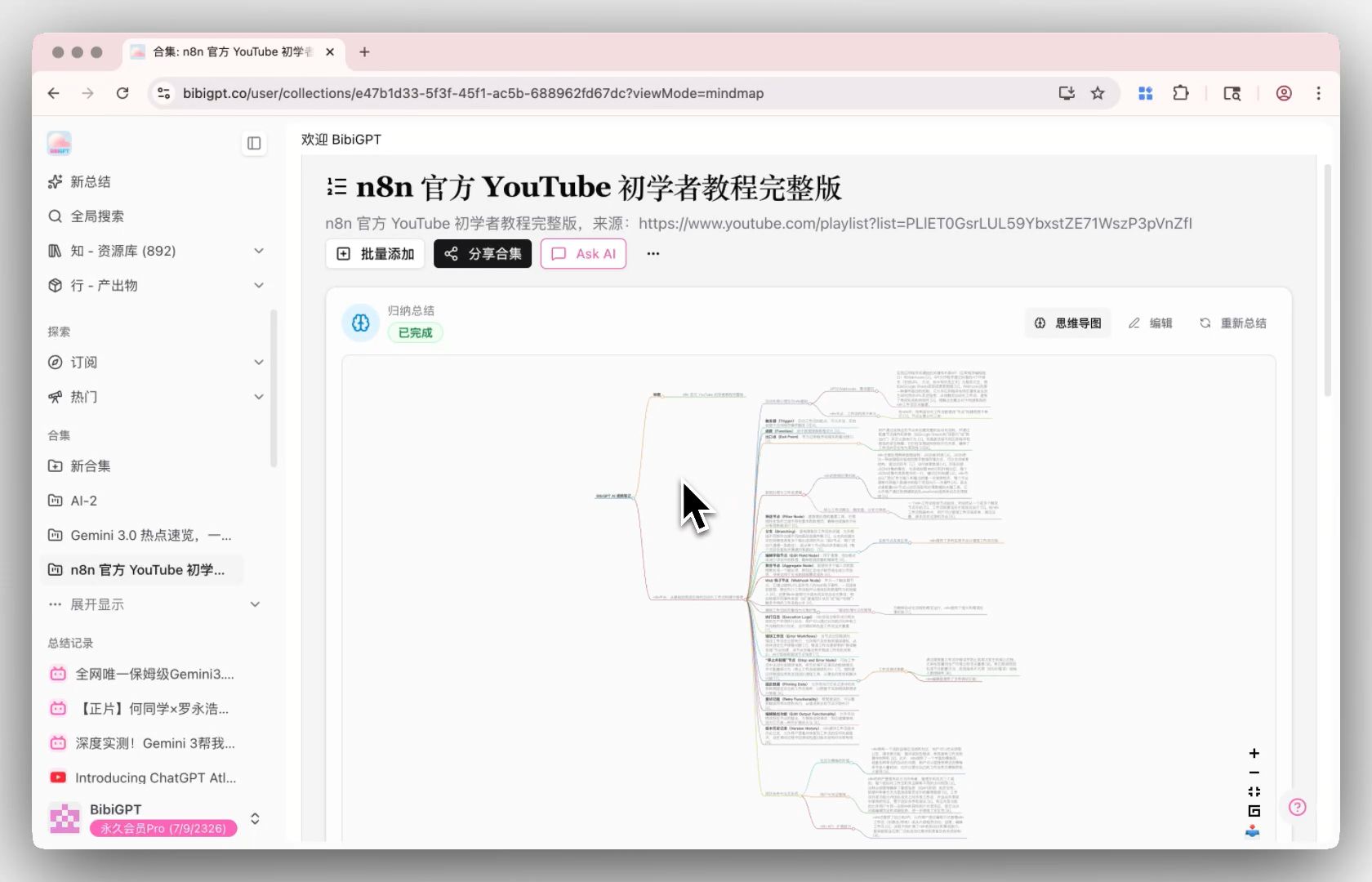 Collection summary mind map
Case Study: Agent Auto-Summarizes Zhang Xuefeng's Gaokao Series
Background: Zhang Xuefeng's gaokao prep series on Bilibili spans 80+ episodes (30-60 min each). Watching everything would take 40+ hours.
Agent workflow:
Step 1: Collect
You: Add the first 30 episodes of Zhang Xuefeng's gaokao
     series to the "Gaokao Prep" collection

Step 2: Agent batch processing (~45 min for 30 episodes)
OpenClaw: Processing episode 1/30...
          ✅ Episode 1 done
          ✅ Episode 2 done
          ...

Step 3: Generate knowledge system
You: Generate a global summary for this collection
BibiGPT: Analyzing 30 episodes...
         Result:
         - Core knowledge map (with mind map)
         - High-frequency test points (23 core themes)
         - Subject allocation recommendations
         - Clickable citations (back to original video)
Actual result: What would've taken 25+ hours of course preview was compressed into 2 hours of reading structured summaries + focused re-watching of key episodes.
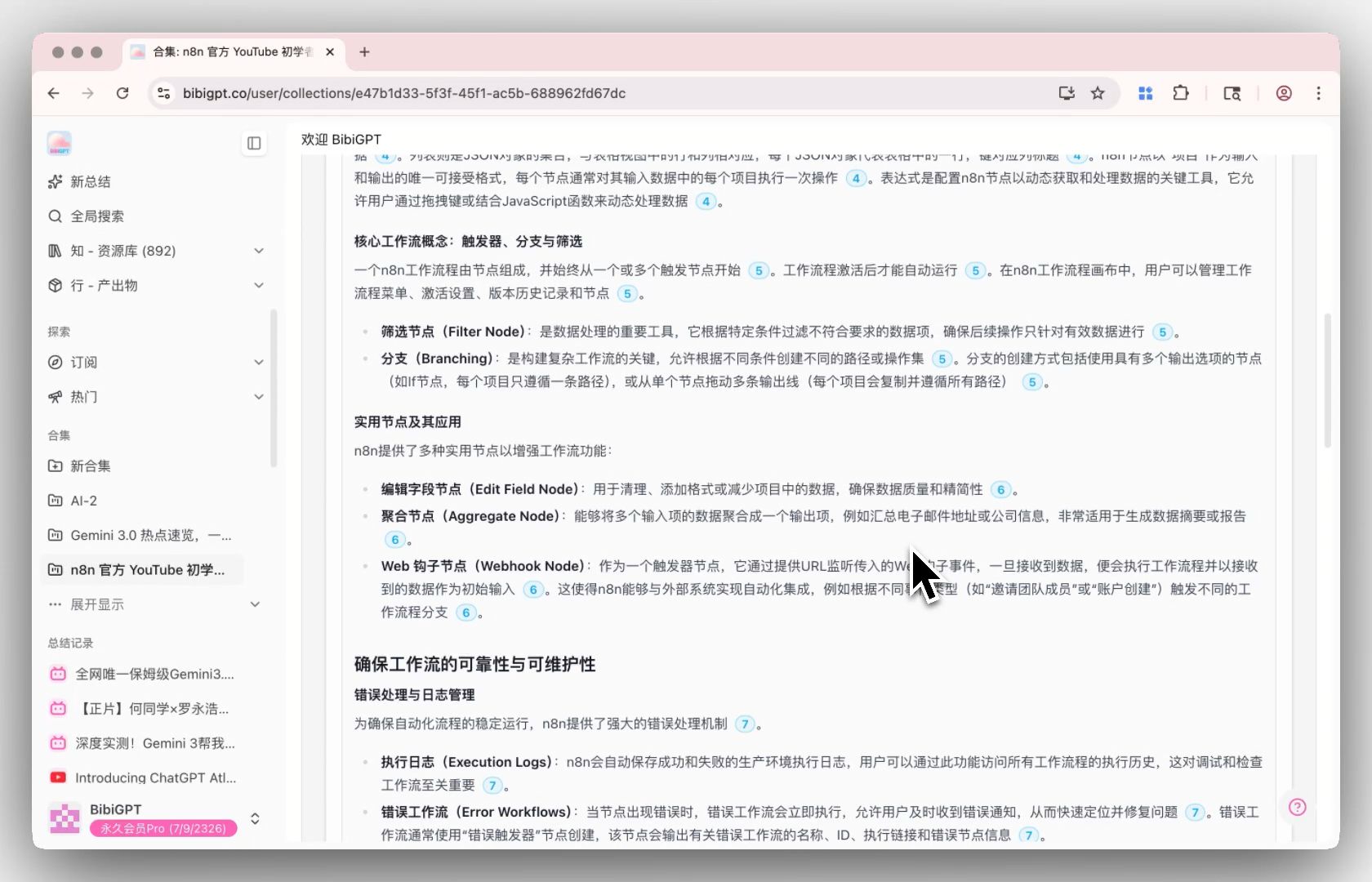 Collection summary text
Full Bilibili Learning Workflow Guide
# 1. Install BibiGPT Desktop
brew install --cask bibigpt  # macOS
winget install BibiGPT.BibiGPT  # Windows

# 2. Install bibigpt-skill
npx skills add JimmyLv/bibigpt-skill

# 3. Verify
bibi auth check
Weekly learning review automation:
Every Sunday evening:
You: Summarize all new videos from my subscribed creators
     this week, organized by subject
OpenClaw: Fetching subscription updates...
          [Batch processing new videos]
          This week's learning digest:
          - Programming: 3 new videos, key points: ...
          - Gaokao prep: 5 new videos, key points: ...
FAQ
Q1: Does danmaku content affect summary quality?
A: BibiGPT uses subtitle text (CC or AI-generated) by default, not danmaku. Danmaku data is only included when the user explicitly enables "include danmaku analysis," ensuring accuracy.
Q2: What if the creator hasn't uploaded subtitles?
A: BibiGPT has a three-tier fallback: CC subtitles → AI-generated subtitles → audio transcription (Whisper/ElevenLabs). Even without uploaded subtitles, speech recognition generates transcripts for summarization.
Q3: Does Collection Summary require all videos to be pre-summarized?
A: Yes. The collection summary is based on already-summarized video content, so you need to process them individually first (Agent can batch-execute this), then trigger the collection summary.
Q4: Does bibigpt-skill support Bilibili anime series?
A: Currently supports creator-uploaded videos and series. Licensed anime content (正版剧集) is not supported due to copyright restrictions on subtitle extraction.
Q5: How many episodes can be processed at once?
A: It's recommended to process no more than 50 episodes per Agent task (about 2-3 hours). For larger volumes, batch into multiple runs and aggregate to the same collection.
Start your BibiGPT + Bilibili AI learning journey now:
- 🌐 Official Website: https://aitodo.co
- 📱 Mobile Download: https://aitodo.co/app
- 💻 Desktop Download: https://aitodo.co/download/desktop
- ✨ Learn More Features: https://aitodo.co/features
BibiGPT Team