
Summify vs BibiGPT: AI Video Summarizer Comparison (2026 Guide)
AI video summarizer comparison: Summify and BibiGPT differ in platform coverage, multimodal capabilities, Agent Skill integration, and pricing. This guide compares 6 key dimensions to help you choose the best AI summarizer.
Summify vs BibiGPT: AI Video Summarizer Comparison (2026 Guide)
The Bottom Line: Summify or BibiGPT?
With thousands of YouTube videos, podcasts, and online courses published daily, you simply cannot watch them all. You need an AI video summarizer to extract the key points fast -- but which one should you choose between Summify and BibiGPT?
Direct answer: Summify is an AI-powered knowledge tool focused on YouTube videos and podcasts, supporting 130+ languages with 11 summary styles. It has processed over 29 million minutes of content for 50,000+ users. BibiGPT is a comprehensive AI audio-video assistant covering 30+ platforms with 1M+ users and 5M+ AI summaries generated. The core difference: Summify focuses primarily on YouTube and podcasts, while BibiGPT uniquely supports Bilibili, Douyin, Xiaohongshu, Kuaishou, and TikTok -- the dominant Chinese video platforms. Summify specializes in text-based summaries, while BibiGPT delivers mind maps, AI Q&A dialogue, flashcards, article rewriting, and multimodal visual analysis. If you only consume English YouTube content, Summify is a clean choice. If you need multi-platform coverage or a complete knowledge workflow, BibiGPT is the more comprehensive solution.
试试粘贴你的视频链接
支持 YouTube、B站、抖音、小红书等 30+ 平台
Feature Comparison Table
| Dimension | Summify | BibiGPT |
|---|---|---|
| Core Focus | YouTube/Podcast AI summarizer | Full AI audio-video assistant |
| Video Platforms | Primarily YouTube | 30+ platforms (YouTube, Bilibili, Douyin, Xiaohongshu, TikTok, Kuaishou, etc.) |
| Podcast Support | Podcasts + voice notes | 9 platforms (Apple, Spotify, Xiaoyuzhou, etc.) |
| Summary Styles | 11 styles (TL;DR, key insights, blog draft, social post, etc.) | Deep structured summary + custom prompts |
| AI Chat | Supported (transcript-grounded) | Video-traced Q&A (jump to timestamps) |
| Mind Maps | Not supported | Markmap + XMind dual format |
| Flashcards | Quiz feature | Spaced-repetition flashcards |
| Transcript Extraction | YouTube transcripts | 30+ platform transcript extraction |
| Subtitle Translation | Not supported | Multilingual translation and hardcoding |
| Content Repurposing | Social posts/blog drafts | WeChat articles, Xiaohongshu posts, PPTs, and more |
| Visual Analysis | Not supported | AI frame analysis (multimodal visual understanding) |
| Knowledge Management | Pods (themed collections) | Deep Notion, Obsidian, Readwise integration |
| Clients | Web + Chrome extension | Web + Desktop (macOS/Windows) + Mobile + Browser extension |
| Agent/Skill Integration | Not supported | bibigpt-skill (gives AI Agents video understanding) |
| Language Support | 130+ languages | Chinese/English/Japanese/Korean/Traditional Chinese + multilingual summaries |
| User Base | 50,000+ users | 1M+ users, 5M+ AI summaries |
Summify Deep Dive: What It Does Well
Summify (summify.io) is a rising AI summarization tool built by a team focused on knowledge management. It has attracted teams from Meta, MIT, Cornell, and PwC.
Summify Strengths
- 11 Summary Styles: From quick TL;DR to academic format, plus social post and blog draft templates. This multi-style design is especially useful for content creators who need different output formats
- Pods Knowledge Collections: Summify's unique Pods concept lets you organize content into themed collections with semantic search, sharing, and public publishing. Great for topic-based research
- Transcript-Grounded AI Chat: When you ask "what did they say about X?", Summify answers from the actual video transcript, not generic AI responses
- Voice Note Transcription: Record voice notes that automatically get transcribed and summarized -- useful for meeting notes and idea capture
- Chrome Extension: Summarize YouTube videos directly on the page without navigating away
- One-Time Payment: $179 for lifetime access, which offers good value for committed long-term users
Summify Limitations
- Single Video Platform: Primarily supports YouTube. No support for Bilibili, Douyin, Xiaohongshu, TikTok, or Kuaishou -- a dealbreaker for anyone consuming Chinese video content
- No Mind Maps: Cannot visualize video content as mind maps, limiting knowledge structure overview
- No Multimodal Visual Analysis: Only analyzes subtitle text, cannot understand video frames. Misses critical visual information in tutorials, product demos, and presentations
- No Agent/Skill Integration: Cannot be called by AI Agents, cannot be integrated into automated knowledge workflows
- Limited Note Tool Integration: Lacks deep integration with Notion, Obsidian, and other mainstream note-taking tools
- Smaller User Base: 50,000+ users compared to BibiGPT's 1M+, indicating less ecosystem maturity
BibiGPT Multimodal AI Summary Deep Dive
BibiGPT is not just a subtitle summarizer -- it is a complete AI assistant covering the entire knowledge loop of listening, watching, reading, thinking, and writing.
30+ Platform Coverage: Exclusive Chinese Platform Support
This is BibiGPT's most powerful differentiator. Whether you are watching Bilibili tech tutorials, Douyin financial analysis, Xiaohongshu lifestyle content, or YouTube English courses, BibiGPT summarizes them all with a single link paste. This cross-platform coverage is something Summify simply cannot match.
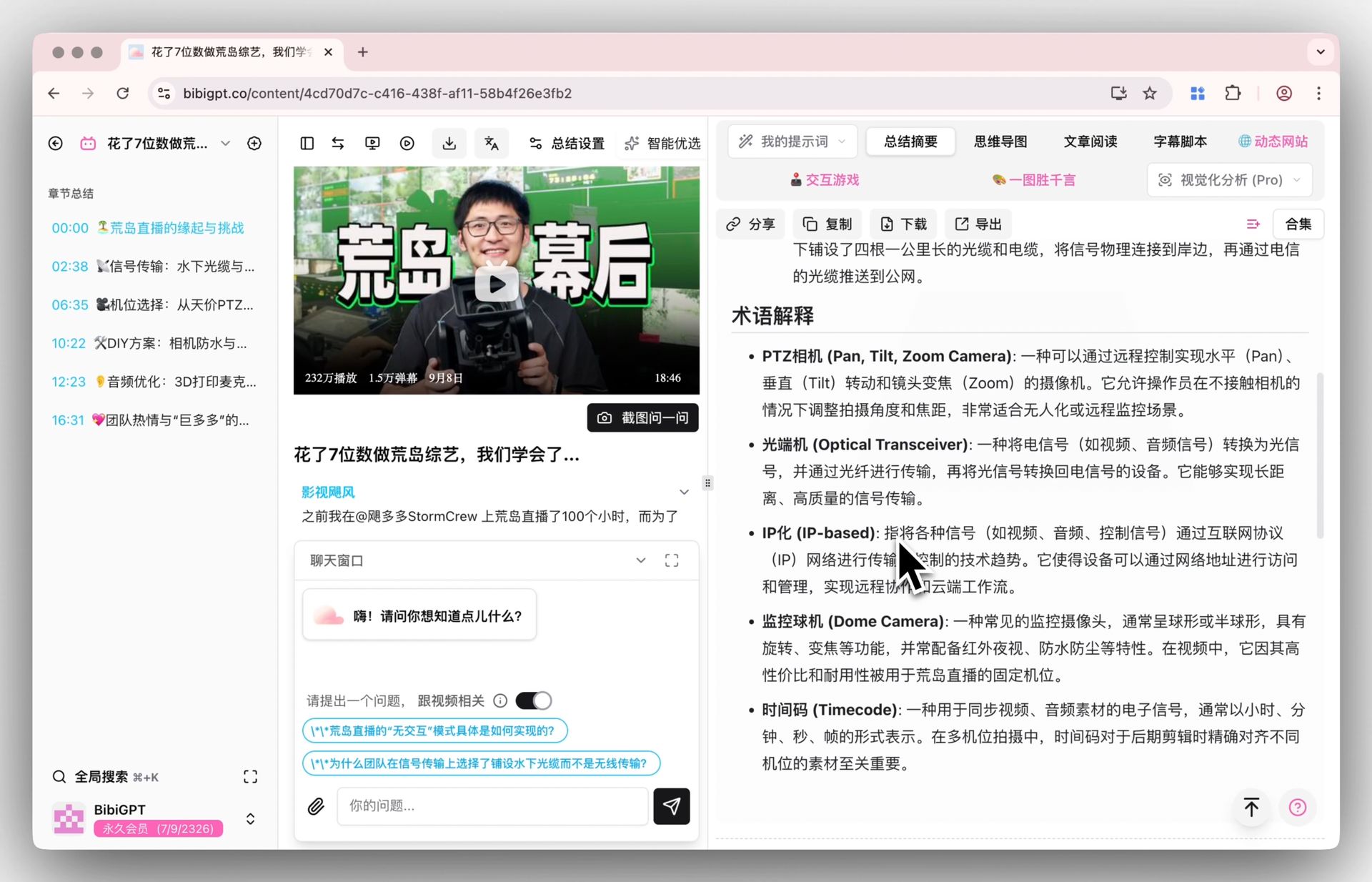 Smart Deep Summary
Multimodal Visual Analysis: Beyond Subtitles
Traditional AI summarizers (including Summify) only analyze subtitle text. BibiGPT's visual analysis feature understands video frame content -- code screenshots in tutorials, UI operations in product demos, data charts in presentations. For scenarios requiring deep visual understanding (tech tutorials, product reviews, design shares), this is a game-changer.
Mind Maps: One-Click Knowledge Visualization
BibiGPT automatically converts video content into structured mind maps, supporting both Markmap (interactive web format) and XMind professional format. You can seamlessly switch between text summary and mind map in the same interface.
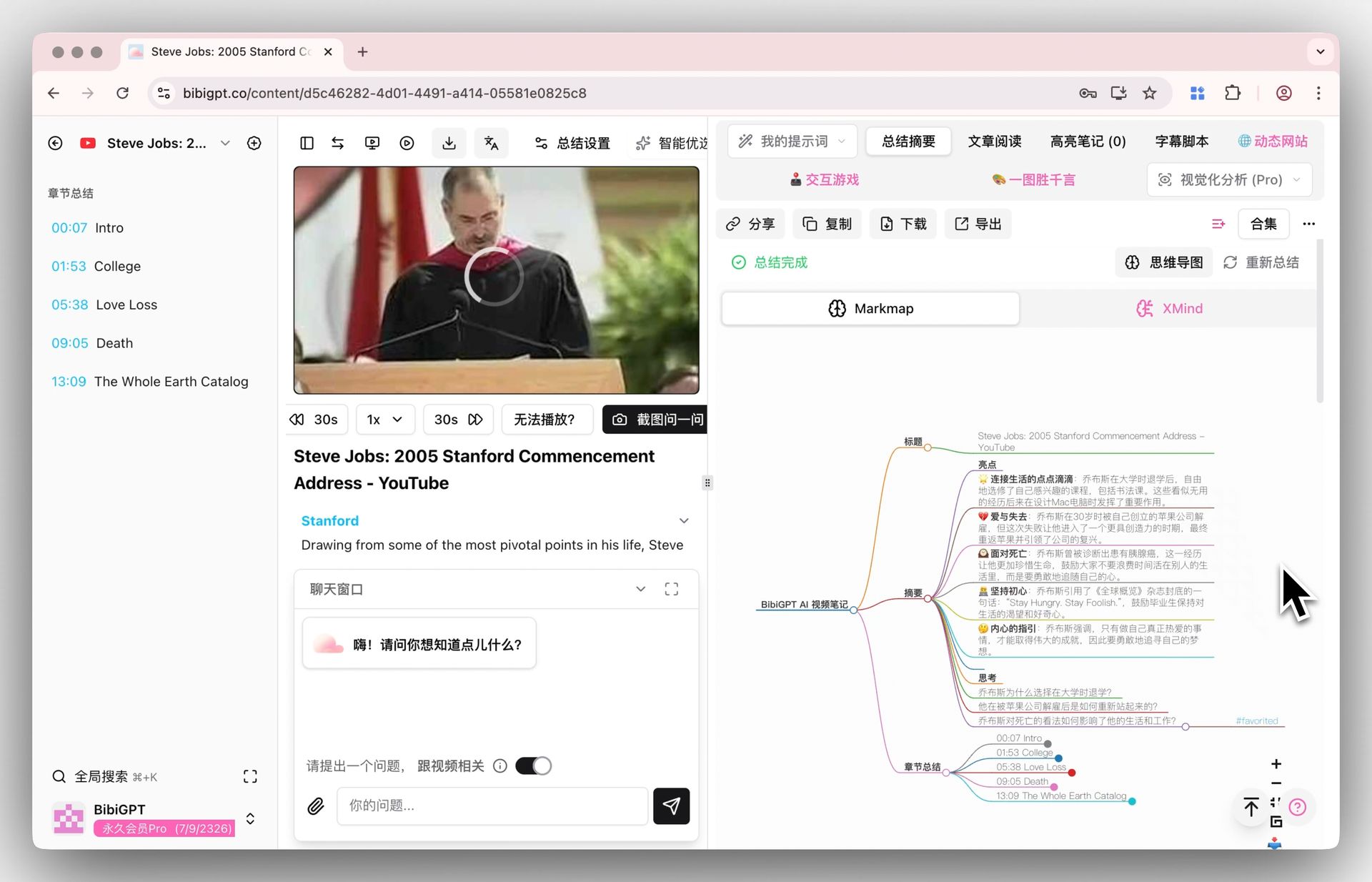 Mind Map Display
This gives you a "global view" that Summify's text-only summaries cannot provide -- you can quickly grasp the entire knowledge structure of a video, not just a linear list of key points. Learn more about how BibiGPT mind maps enhance learning efficiency.
AI Q&A Dialogue: The Core of Deep Learning
BibiGPT's AI chat goes beyond simple Q&A. Every answer traces back to a specific timestamp in the video, and you can click to jump directly to that moment. This "ask while watching" experience transforms video learning from passive consumption to active exploration.
Agent Skill: Giving AI the Ability to "Watch Videos"
This is a capability dimension that Summify lacks entirely. BibiGPT provides bibigpt-skill, allowing AI Agent platforms like Claude Code and OpenClaw to natively call BibiGPT's video understanding capabilities. Your AI Agent can automatically process video content -- auto-summarize new channel uploads, batch-analyze competitor videos, build video knowledge bases, and more.
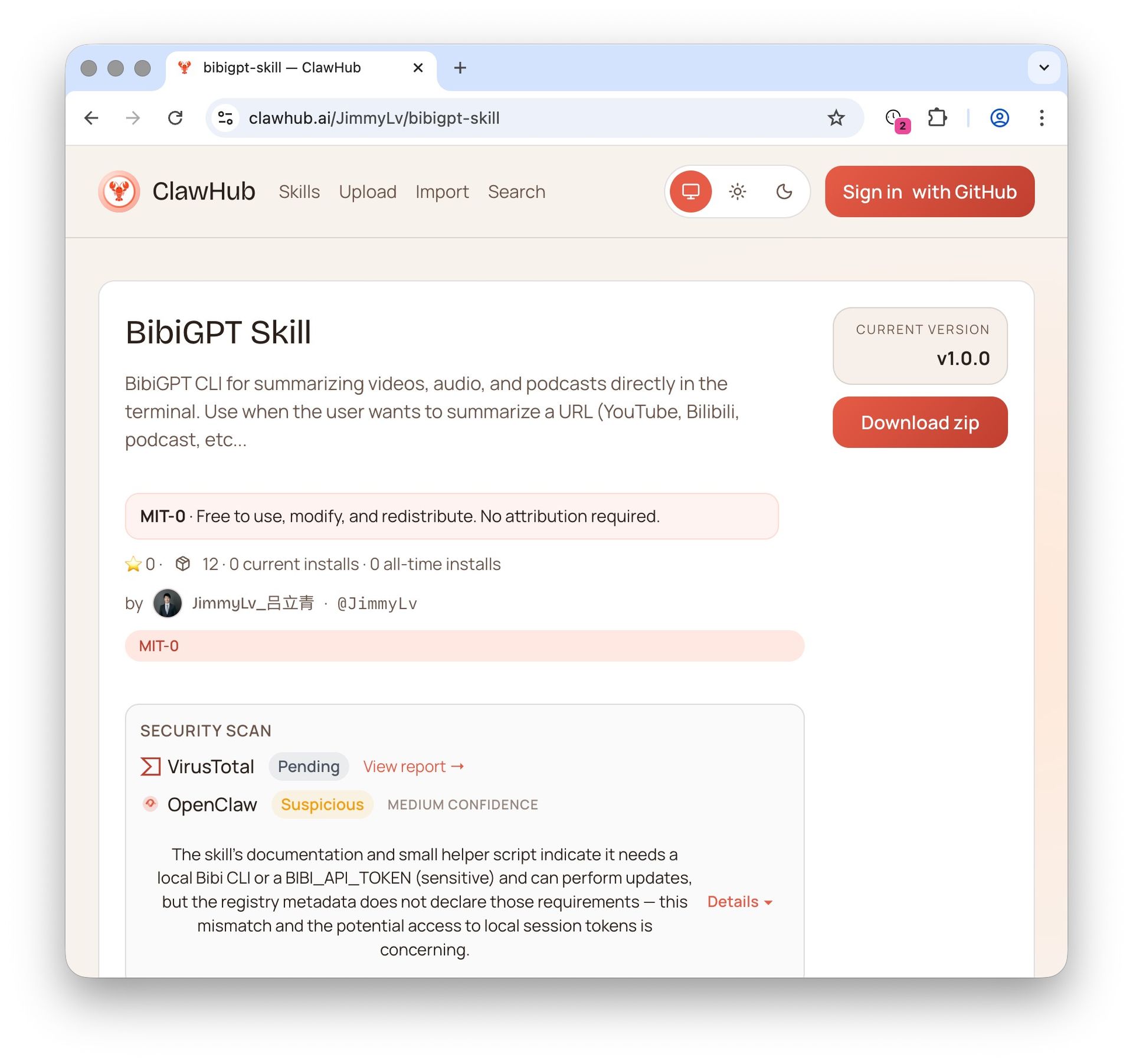 Agent Skill
For knowledge workers and developers, this Agent-native integration represents the next generation of AI video summarization tools.
看看 BibiGPT 的 AI 总结效果
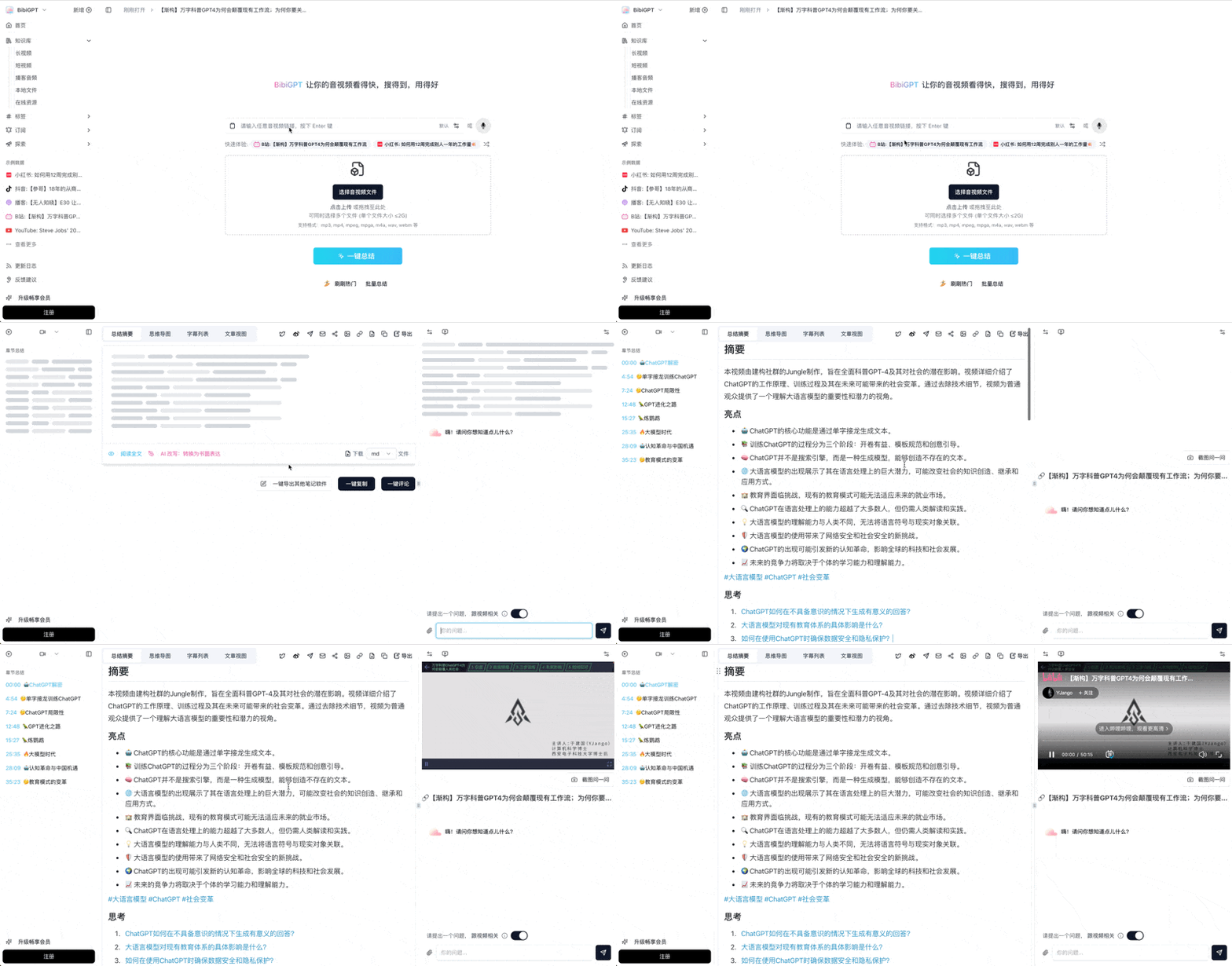
Let's build GPT: from scratch, in code, spelled out
Andrej Karpathy walks through building a tiny GPT in PyTorch — tokenizer, attention, transformer block, training loop.
Use Case Comparison
Scenario 1: Quick YouTube Video Takeaways
Summify: Smooth experience with 11 summary styles for different needs. Pods feature is convenient for organizing research.
BibiGPT: Also supports YouTube summaries, plus mind maps, AI Q&A, and full transcript extraction.
Recommendation: Light browsing -- Summify. Deep learning -- BibiGPT.
Scenario 2: Chinese Video Platforms (Bilibili/Douyin/Xiaohongshu)
Summify: Not supported.
BibiGPT: Full support. This is BibiGPT's home turf. See our Bilibili video-to-text feature.
Recommendation: Only BibiGPT can serve this need.
Scenario 3: Content Creation -- Turning Videos into Articles
Summify: Can generate blog drafts and social posts, but limited to YouTube content.
BibiGPT: Supports generating WeChat articles, Xiaohongshu posts, PPTs, and more from 30+ platform videos. Visual analysis captures key information from video frames.
Recommendation: English content -- both work. Chinese content -- only BibiGPT.
Scenario 4: Batch Video Processing and Automation
Summify: No Agent integration or batch API.
BibiGPT: Through bibigpt-skill and API, supports batch video processing and automated workflows. Enterprise users can call the API in bulk.
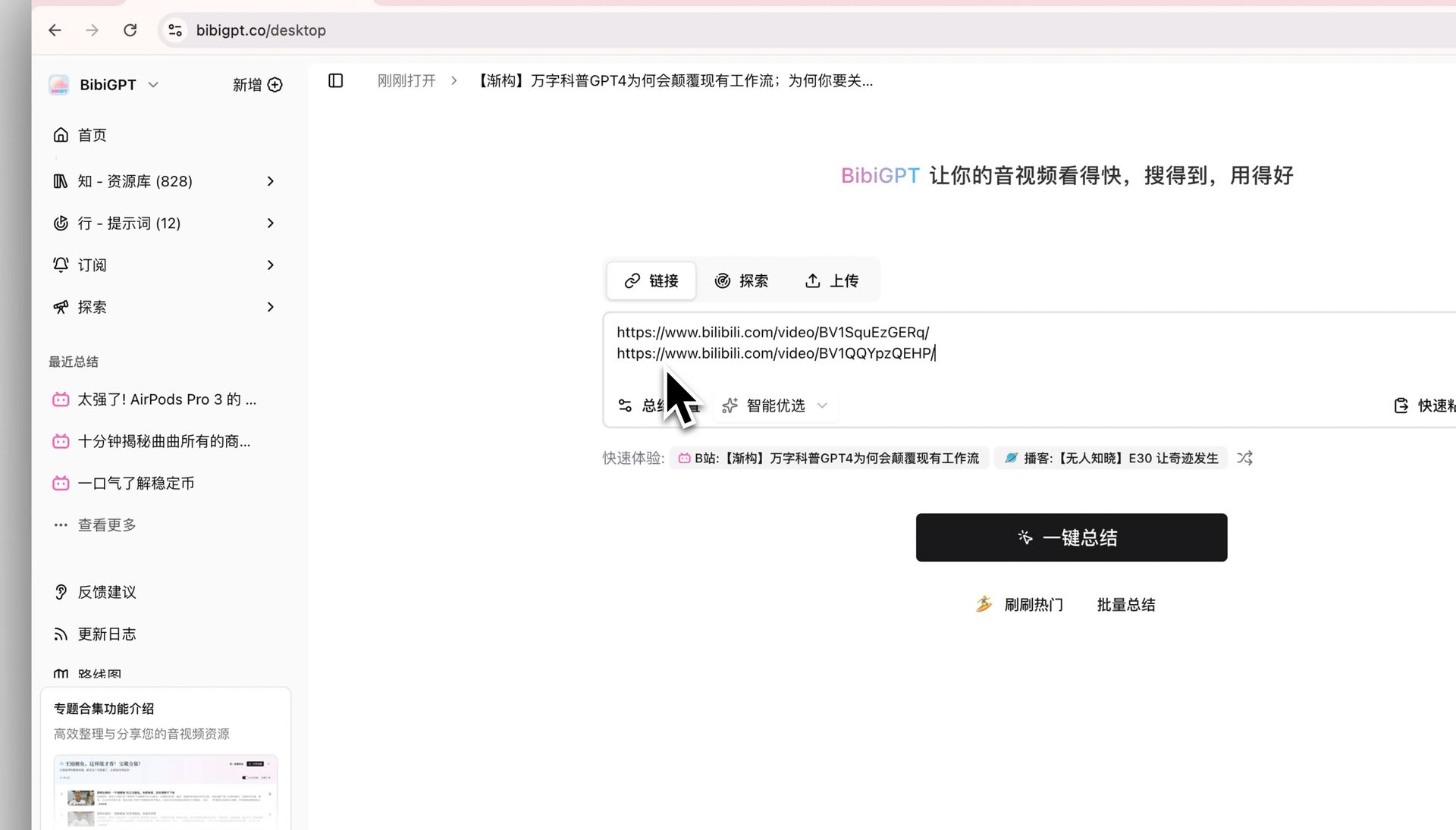 Batch Processing
Recommendation: For automation needs, choose BibiGPT.
Scenario 5: Academic Research and Knowledge Management
Summify: Pods knowledge collections and semantic search are highlights, great for topic-based research within the Summify ecosystem.
BibiGPT: Deep integration with Notion, Obsidian, and Readwise. Spaced-repetition flashcards provide a more complete knowledge retention path.
Recommendation: English-only research -- Summify Pods is nice. Multi-platform, multilingual research -- BibiGPT.
Pricing Comparison
| Dimension | Summify | BibiGPT |
|---|---|---|
| Free Tier | Free version available | Free trial credits for new users |
| Pricing Model | $179 one-time lifetime payment | Subscription (Plus/Pro) + pay-as-you-go |
| Pro Features | Voice notes, PDF export, priority support | Multimodal analysis, Agent Skill, batch processing |
| Enterprise | None | API pay-as-you-go, enterprise batch processing |
| Flexibility | One-time payment, permanent access | Subscription + pay-as-you-go dual mode |
Summify's $179 lifetime plan offers solid value for committed YouTube summarization users. BibiGPT's subscription model is more flexible -- light users can pay as they go, heavy users can subscribe monthly/annually, and enterprise users have dedicated API plans.
How to Choose: Decision Guide
Choose Summify if you:
- Primarily consume YouTube English videos and podcasts
- Prefer a one-time payment over monthly subscriptions
- Need quick social post or blog draft generation from videos
- Like Pods-style topic knowledge management
- Do not need Chinese video platform support
Choose BibiGPT if you:
- Consume content from Bilibili, Douyin, Xiaohongshu, or other Chinese platforms
- Need mind maps + AI summaries + Q&A + flashcards as a complete workflow
- Consume content across 30+ platforms
- Are a content creator needing to repurpose videos into multiple formats
- Need AI frame analysis (multimodal visual understanding)
- Are a developer or knowledge worker needing Agent Skill automation
- Want deep integration with Notion, Obsidian, or Readwise
For a broader comparison of AI summarizers, check out our multi-model AI summarizer comparison.
FAQ
Which has better summary quality: Summify or BibiGPT?
Both produce quality AI summaries. Summify offers 11 customizable summary styles for different reading preferences. BibiGPT's deep structured summaries have higher information density and support custom prompts. BibiGPT's additional multimodal visual analysis makes summaries more comprehensive -- capturing not just dialogue and subtitles but also key visual elements from video frames.
Does Summify support Bilibili video summaries?
No. Summify primarily supports YouTube videos and podcast content. It does not support Bilibili, Douyin, Xiaohongshu, TikTok, Kuaishou, or other Chinese video platforms. If you need to summarize Chinese video platform content, BibiGPT offers the most comprehensive coverage with AI Bilibili video summary and 30+ other platforms.
Are there free AI video summarizer tools?
Summify offers a free version with limited features. BibiGPT provides free trial credits for new users. Both let you try AI video summarization for free. For long-term heavy use, both require payment. BibiGPT's pay-as-you-go option is particularly friendly for occasional users who do not want to commit to a subscription.
What is BibiGPT's Agent Skill and what is it for?
BibiGPT's bibigpt-skill enables AI Agent platforms (such as Claude Code and OpenClaw) to natively call BibiGPT's video understanding capabilities. Practical use cases include automatically summarizing new videos from subscribed channels, batch-analyzing competitor content, and building team video knowledge bases. This represents the evolution of AI tools from "human-operated tools" to "Agent-operated tools."
Which is better: Summify Pods or BibiGPT note integration?
They take different approaches. Summify Pods is a self-contained themed knowledge collection system with semantic search and public sharing, ideal for research within the Summify ecosystem. BibiGPT integrates deeply with existing note tools (Notion, Obsidian, Readwise), letting summary content flow naturally into your existing knowledge management system. If you already use Notion or Obsidian extensively, BibiGPT's integration is more seamless.
Try BibiGPT Now
- 🔗 Try BibiGPT Free
- 📱 Supports 30+ platforms — just paste a link
- 🧠 AI Q&A, mind maps, and article rewriting in one place