
After Converting Aliyun Drive Videos to Text: How to Take Notes and Organize Long-term in 2025?
Explore note-taking solutions after converting Aliyun Drive videos to text. Learn about Tongyi Tingwu's transcription capabilities and how BibiGPT enables long-term management and systematic organization of audio-video content, turning transcriptions into reusable knowledge assets.
After Converting Aliyun Drive Videos to Text: How to Take Notes and Organize Long-term in 2025?
If you're already using Aliyun Drive and have experienced its built-in audio-video-to-text capabilities (such as Tongyi Tingwu), you'll likely have this impression:
The transcription step is already done very well.
Whether it's automatic transcription, segmented summaries, keyword extraction, or meeting minutes generation, Aliyun Drive and Tongyi Tingwu have already covered most of the basic needs for "AI audio-video transcription."
The real problem often appears after transcription is complete.
Experience BibiGPT now
Ready to try these powerful features? Visit BibiGPT and start your intelligent audio/video summarization journey!
Get startedPart 1: Aliyun Drive + Tongyi Tingwu: AI Audio-Video Transcription is Already Mature
Let's be clear about the conclusion:
- If you only want to quickly convert videos or audio in Aliyun Drive to text
- And mainly complete viewing and simple review within the Aliyun Drive ecosystem
Then, Aliyun Drive + Tongyi Tingwu is already a highly complete solution.
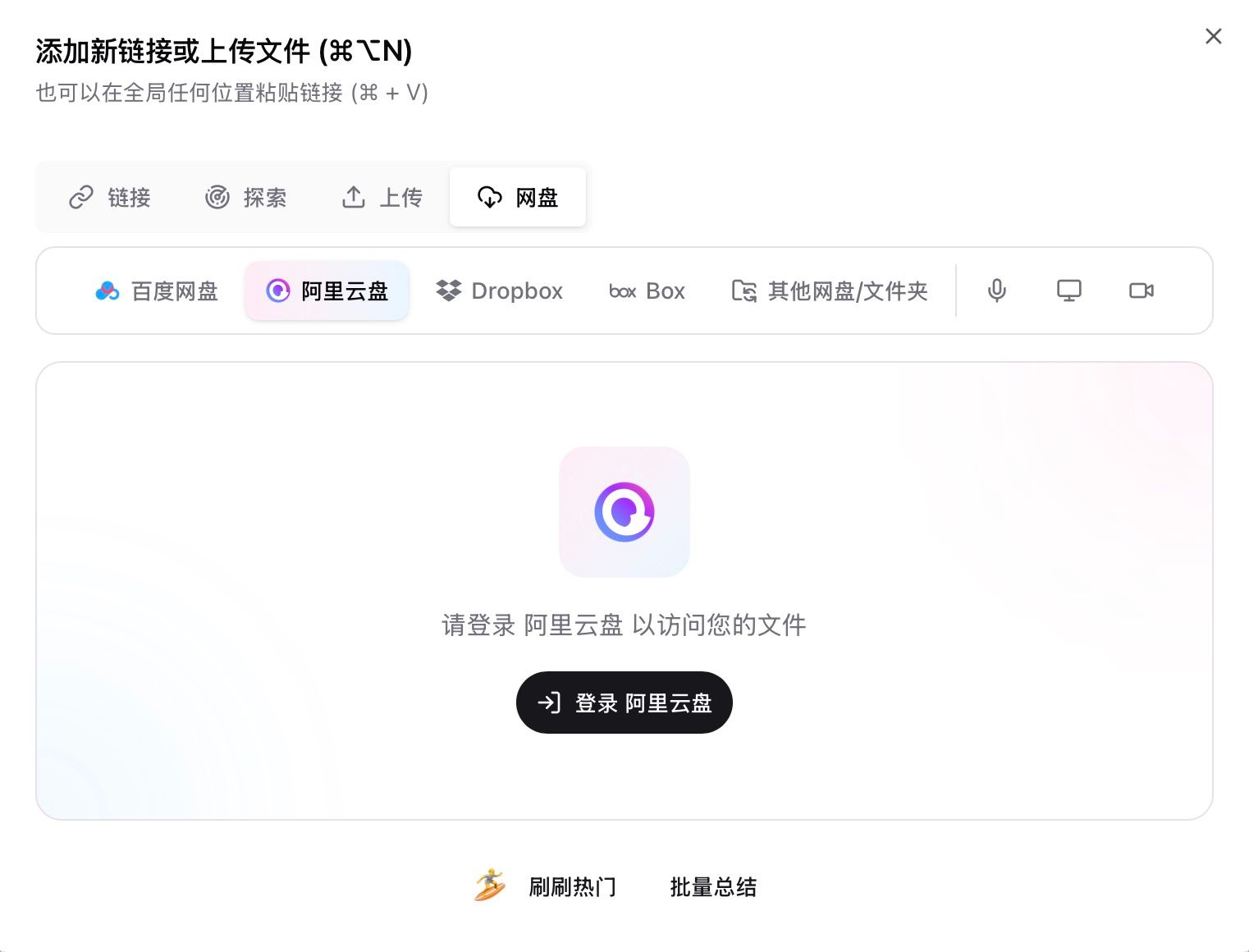 Aliyun Drive Entry
Through Tongyi Tingwu, you can:
- Upload audio-video for AI transcription
- Automatically distinguish speakers
- Generate segmented summaries and structured content
- Quickly browse core information from long videos
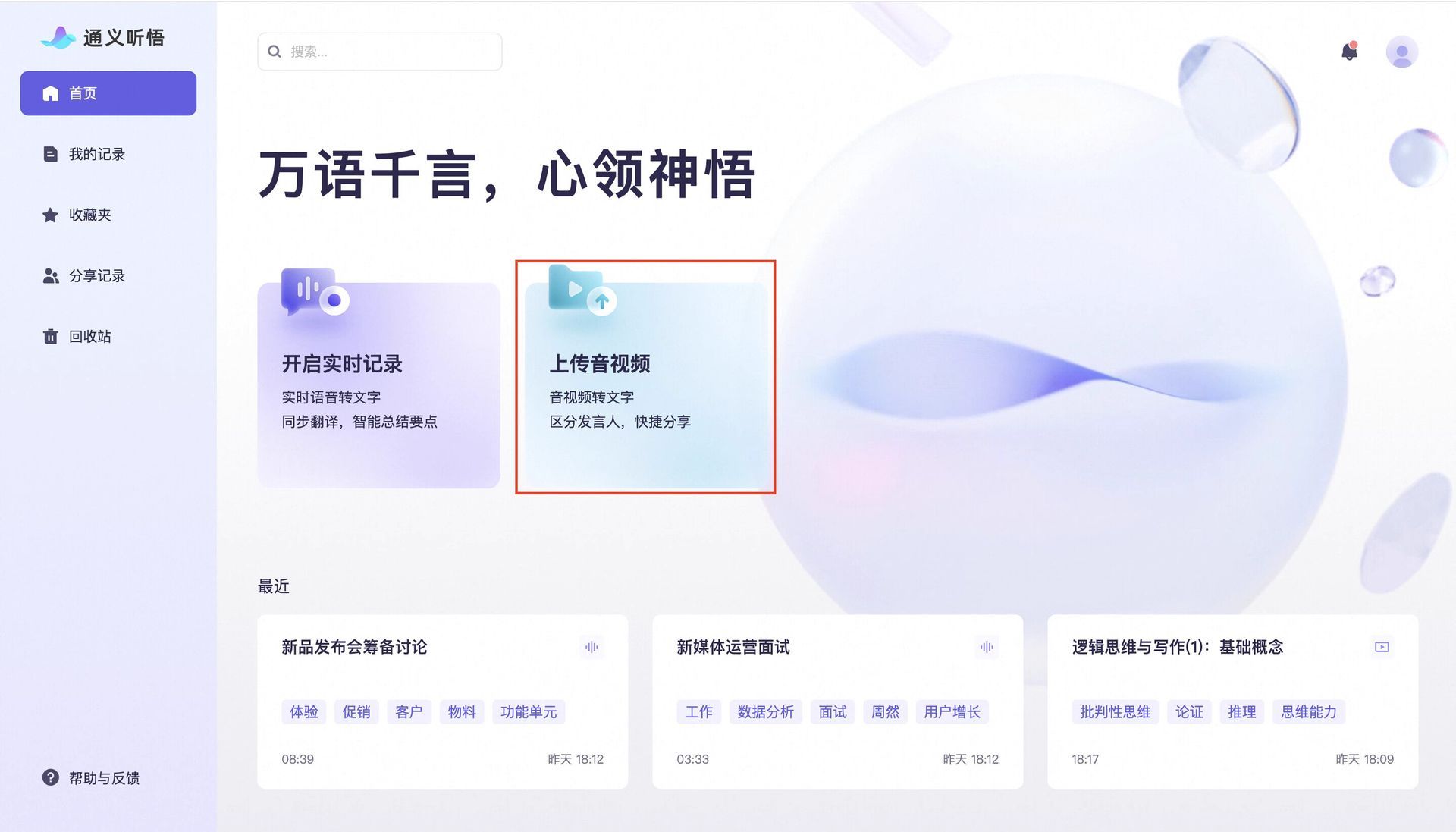 Tongyi Tingwu Entry
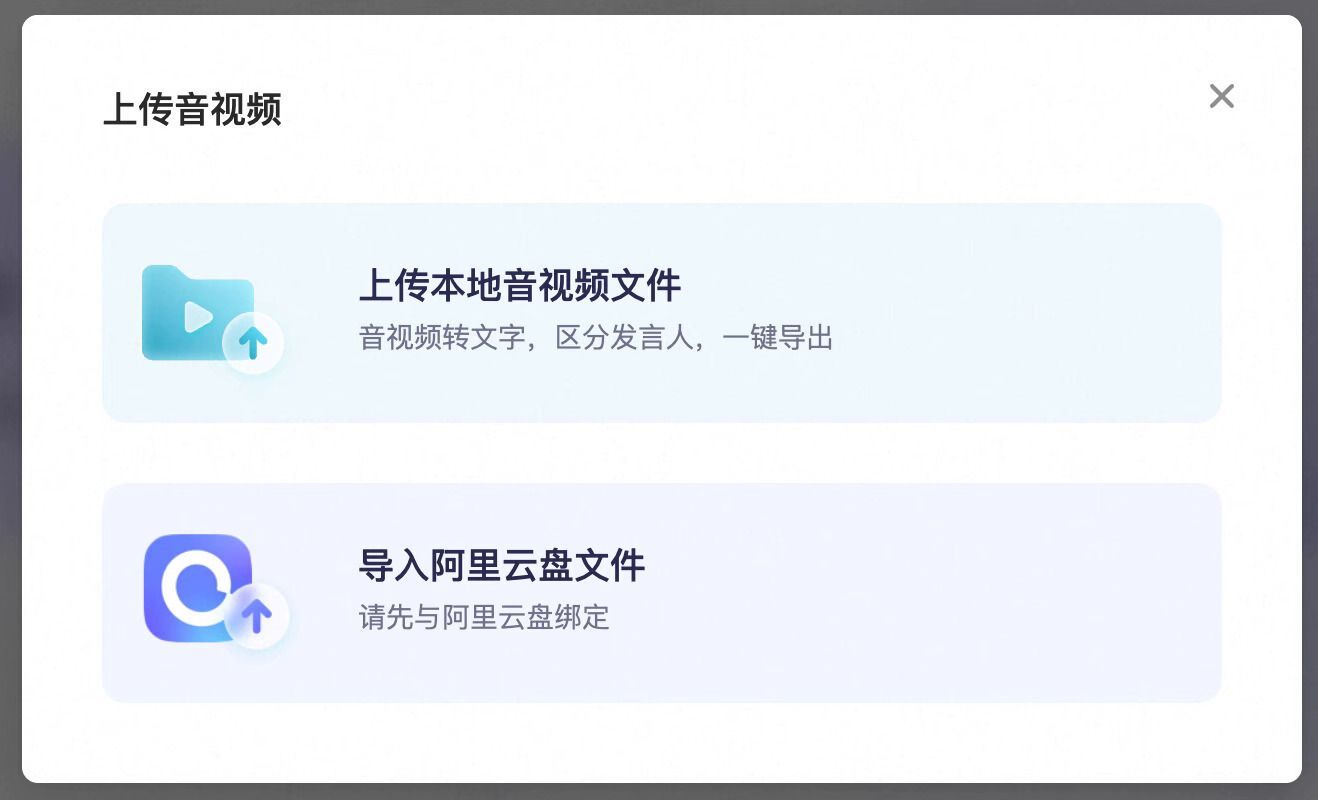 Tongyi Tingwu Bind Aliyun Entry
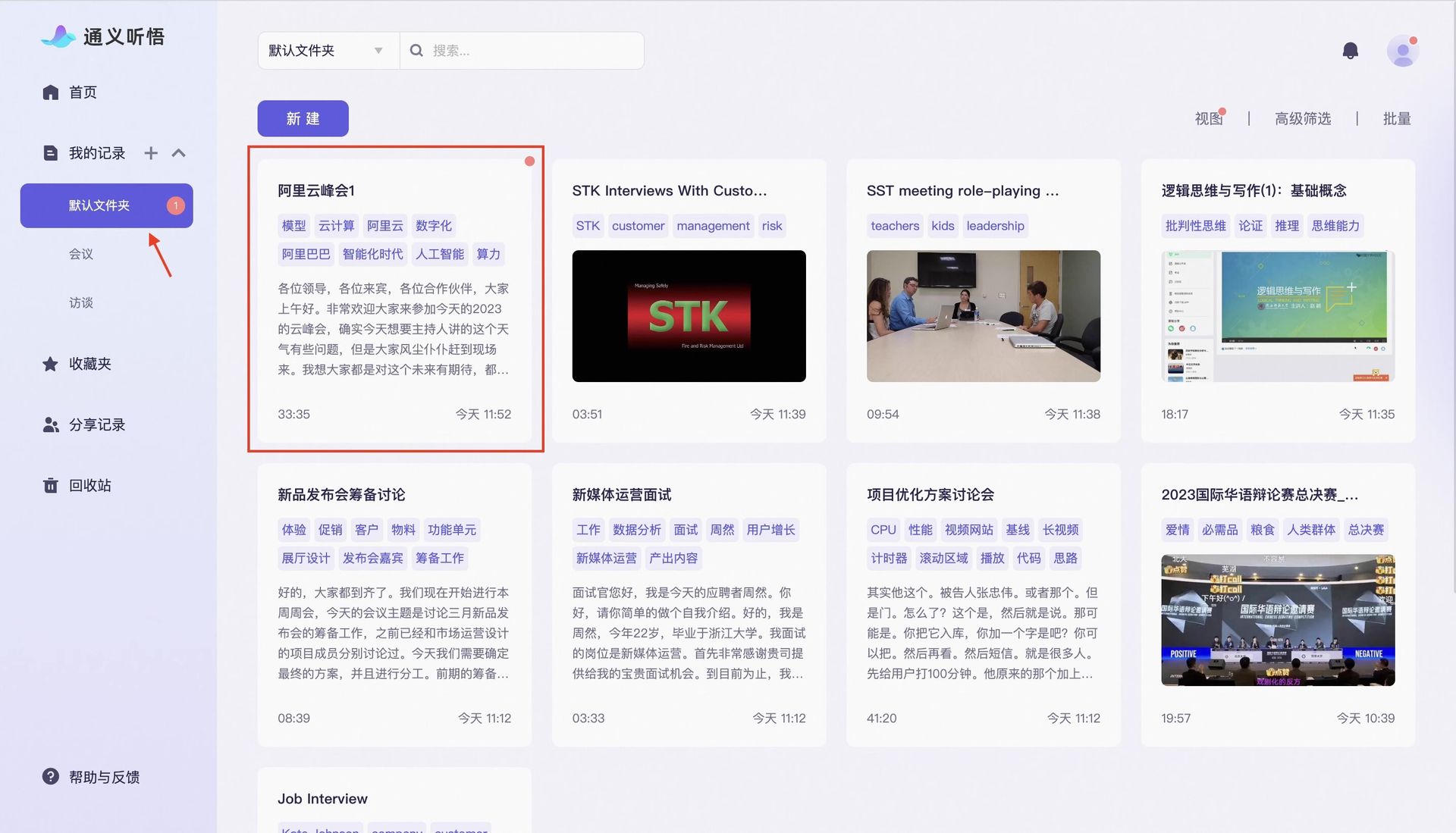 Tongyi Tingwu Transcription Result
When it comes to "single content understanding efficiency," Aliyun Drive has done well enough.
Part 2: The Problem Isn't "How to Transcribe," But "What to Do After Transcription"
Many users gradually encounter similar problems after using it for a while:
- There are many transcriptions, but rarely reviewed
- Notes from different videos are independent, not connected
- After some time, you only remember "seems like I watched it," but can't find key information
- Learned content is difficult to accumulate into long-term usable materials
This isn't a problem with AI audio-video transcription tools, but a more typical learning and management problem:
Content has been transcribed, but hasn't been systematically organized.
Part 3: Why Taking Notes Only in Aliyun Drive Tends to Become Scattered?
A reality is:
Even if you mainly use Aliyun Drive, your audio-video sources are often not limited to one.
For example:
- Courses and meeting recordings in Aliyun Drive
- Public videos from platforms like Bilibili, YouTube
- Local recordings, interviews, screen recordings
- Learning materials accumulated from different channels
If each platform completes transcription and saves notes separately, over time, it's easy to encounter:
- Content scattered across different systems
- Inconsistent note formats and structures
- Difficulty forming a long-term reusable knowledge system
At this point, the problem has evolved from "AI video transcription" to:
How to uniformly organize and manage audio-video content from different sources?
Part 4: Two Different Approaches: Transcription Tools vs. Long-term Organization Systems
We can simply divide the approaches into two categories:
-
Transcription-oriented:
Focuses on "how to quickly understand this one video" -
System-oriented:
Focuses on "how to accumulate, reuse, and connect all videos long-term"
Aliyun Drive + Tongyi Tingwu leans more toward the former;
Tools like BibiGPT, an AI audio-video summary tool, lean more toward the latter.
Part 5: Two Usage Methods Provided by BibiGPT (Brief Overview)
In BibiGPT, AI audio-video transcription and organization can be completed in two ways.
1️⃣ Manual Import: Process Individual Content On-Demand
When you want to organize a specific audio-video, you can directly import:
- Local audio-video files
- Specified files from cloud drives
- Video content from different platforms
BibiGPT will complete a unified processing workflow:
- AI audio-video transcription
- Structured summaries and key point extraction
- Output unified format organization results
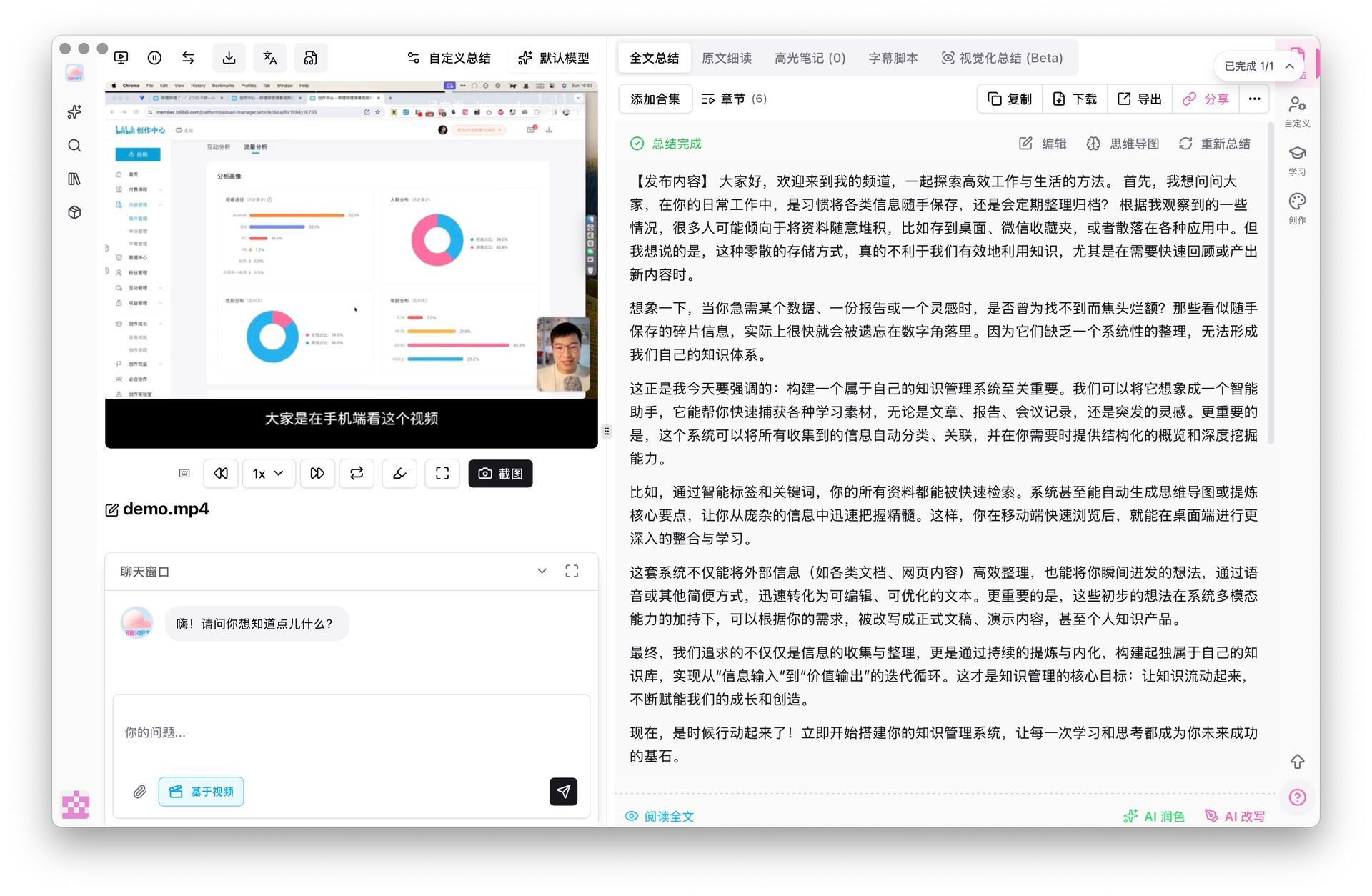 BibiGPT Transcription Result
This method is suitable for scattered organization and temporary review scenarios.
2️⃣ Sync Drive Monitoring: Make Organization an Automatic Process
If you want to make audio-video organization a long-term, low-intervention process, you can use the sync drive monitoring method.
After syncing files to local through official sync drives (such as Aliyun Drive, Baidu Netdisk, etc.), BibiGPT can monitor specified folders:
- Automatically identify when new audio-video files appear
- Automatically perform AI audio-video transcription
- Automatically generate summaries and structured organization results
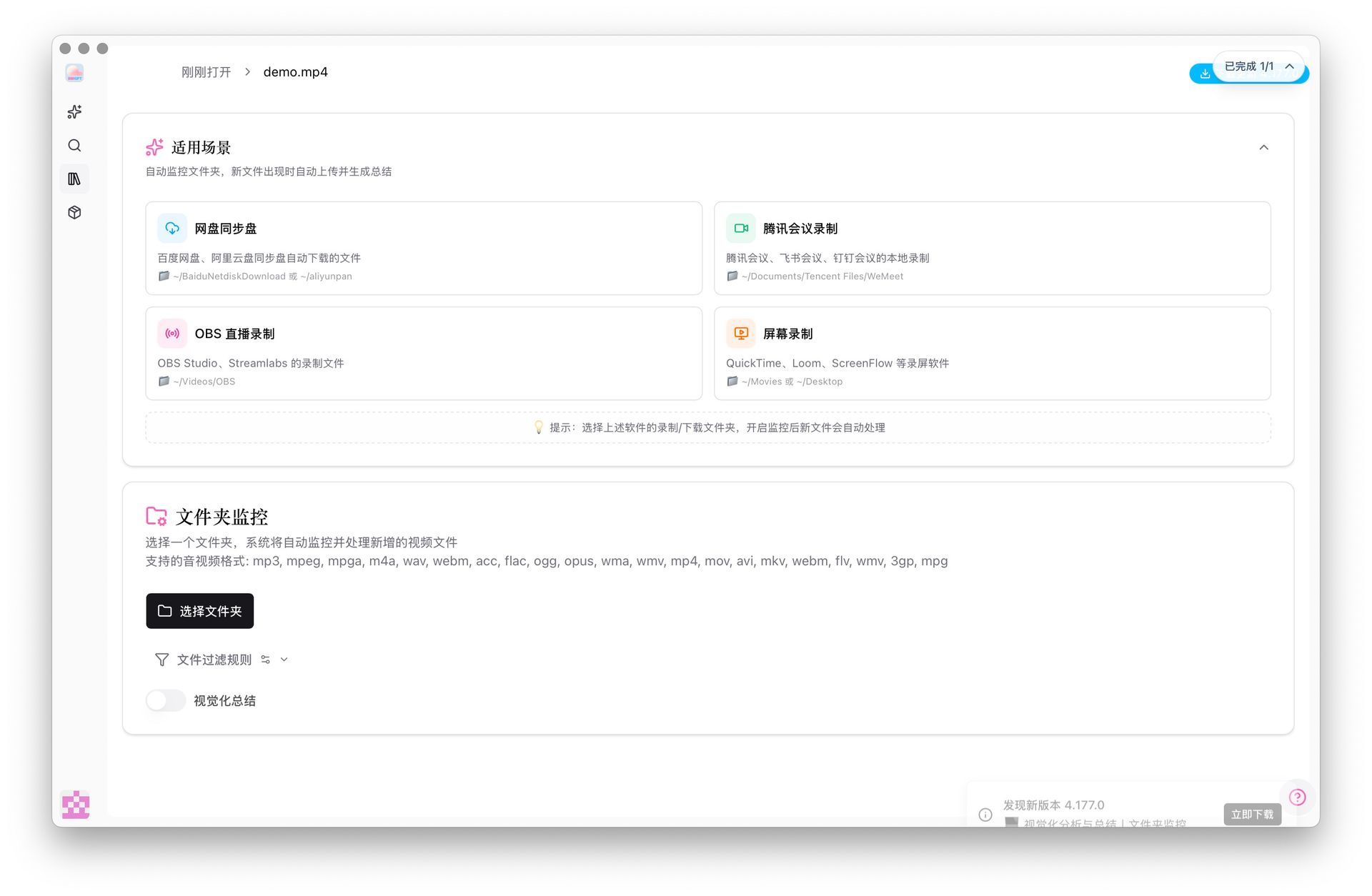 BibiGPT Sync Drive Monitor Entry
This method is more suitable for:
- Long-term learning and content accumulation
- Continuous entry of multi-source audio-video
- Users who want "less operation, but continuous organization"
To learn more about cloud drive sync and automatic organization features, check our Complete Guide to Cloud Drive Video Transcription.
Part 6: Not Replacing Anyone, But Solving the "After Transcription" Problem
It's important to emphasize:
- Aliyun Drive and Tongyi Tingwu are already excellent at the AI video transcription step
- BibiGPT is not meant to replace these capabilities
- It focuses more on: How to integrate transcription results into a long-term usable organization system
When you have more and more audio-video content, what really makes the difference is often not "how accurate the transcription is," but:
Can you still quickly find and reuse this content six months or a year later?
BibiGPT's core value lies in "see fast, search well, use better":
- See fast: Quickly understand core audio-video content through AI summaries and structured output, making information acquisition more efficient
- Search well: Unified search entry, content across platforms and time can be quickly located
- Use better: Support export to note-taking tools like Notion, Obsidian, making knowledge truly integrate into your workflow
Final Thoughts
If you only occasionally organize one or two videos,
Aliyun Drive + Tongyi Tingwu is completely sufficient.
But if you're doing:
- Long-term learning
- Multi-platform content accumulation
- Or want to turn audio-video into reusable knowledge assets
Then, the organization method after AI audio-video transcription is the part worth thinking about more.
BibiGPT is committed to helping users transform audio-video content into long-term usable knowledge assets. Whether you're a student, professional, or content creator, you can achieve more efficient audio-video content management and learning through BibiGPT.
Try BibiGPT now and make audio-video content truly become your knowledge assets!
Have feedback or ideas?
We value your input! If you encounter issues or have suggestions, please let us know anytime.
Submit feedbackExperience BibiGPT now
Ready to try these powerful features? Visit BibiGPT and start your intelligent audio/video summarization journey!
Get started