
Best AI Podcast Transcription & Summary Tools 2026: BibiGPT vs NotebookLM vs Podwise vs Snipd
A thorough comparison of the best AI podcast transcription and summary tools in 2026, covering NotebookLM, Podwise, Snipd, Podsqueeze, NoteGPT, and BibiGPT across platform coverage, transcription accuracy, and knowledge workflows.
Best AI Podcast Transcription & Summary Tools 2026: BibiGPT vs NotebookLM vs Podwise vs Snipd
Why AI Podcast Transcription Tools Deserve a Fresh Look in 2026
Podcast listenership has crossed 500 million globally, with over 100,000 new episodes published every week. Long-form, information-dense shows make it impossible to keep up by listening alone. Meanwhile, Cohere open-sourced its Transcribe speech recognition model in March 2026 — a 2B-parameter ASR model achieving just 5.42% word error rate (WER), the lowest on the Hugging Face Open ASR Leaderboard (source: TechCrunch, March 2026). The barrier to high-accuracy transcription is falling fast. This guide compares six leading tools — NotebookLM, Podwise, Snipd, Podsqueeze, NoteGPT, and BibiGPT — so you can find the best fit for your podcast learning workflow.
Experience BibiGPT now
Ready to try these powerful features? Visit BibiGPT and start your intelligent audio/video summarization journey!
Get startedQuick Comparison: 6 AI Podcast Tools at a Glance
Platform coverage is often the first dealbreaker when choosing a podcast summarizer. If your favorite show is not supported, no feature set can compensate. The table below compares all six tools across platform support, core capabilities, transcription engines, and ideal use cases.
| Feature | BibiGPT | NotebookLM | Podwise | Snipd | Podsqueeze | NoteGPT |
|---|---|---|---|---|---|---|
| Podcast Platforms | 9+ (Apple, Spotify, Xiaoyuzhou, Ximalaya, etc.) | Upload files / paste text | RSS feeds | Apple Podcasts, Spotify | RSS feeds | URL / upload |
| Video Platforms | 30+ (YouTube, Bilibili, TikTok, etc.) | YouTube (limited) | None | None | None | YouTube |
| Custom Transcription Engine | Whisper + ElevenLabs Scribe (switchable) | Gemini built-in | Fixed | Fixed | Fixed | Fixed |
| AI Summary | Structured summary + mind map + flashcards | Audio overview + dual-host dialogue | Outline + highlights + mind map | Chapter summaries + highlights | Show notes + timestamps | Summary + notes |
| AI Follow-up Q&A | Yes, with source tracing | Yes | No | No | No | Yes |
| Note App Integration | Notion / Obsidian / Readwise | Google Docs | Notion / Readwise | Notion / Readwise | None | None |
| Video-to-Podcast | Yes (MP3/OGG, dual-host voice) | Yes (audio overview) | No | No | No | No |
| Best For | Cross-platform power learners | Research-oriented deep analysis | Podcast-native RSS users | On-the-go highlight clippers | Podcast creators | Casual summarizers |
Try pasting your video link
Supports YouTube, Bilibili, TikTok, Xiaohongshu and 30+ platforms
NotebookLM: Google's Research-First Podcast Analyzer
NotebookLM is Google's AI research assistant, best known for its "Audio Overview" feature that turns uploaded documents and audio into a dual-host conversational summary. It now supports over 50 languages including Japanese, making it a strong contender for academic and research use cases.
Key Strengths:
- Audio Overview: Automatically generates a natural two-host dialogue from your sources, ideal for auditory learners
- Citation tracing: Every AI answer links back to the specific source passage, making verification straightforward
- Google ecosystem integration: Seamless connection with Google Docs and Google Drive
Limitations:
- Does not support direct podcast platform links — you must download the audio file and upload it manually
- No subtitle timestamps or sentence-level navigation
- Cannot process video content; limited to text and audio
- Summary style leans academic, with limited customization
NotebookLM is ideal for researchers with a small set of sources who need deep, citation-backed analysis. But for daily podcast triage across a dozen subscriptions, the manual upload workflow creates too much friction.
Podwise: Knowledge Extraction for Podcast Natives
Podwise is a dedicated podcast intelligence tool that syncs episodes via RSS, then generates structured outlines, key takeaways, and mind maps. Fast Company named it among the top three podcast summarizers of 2026 alongside BibiGPT and Snipd.
Key Strengths:
- Auto RSS sync: Subscribe once and new episodes are processed automatically — no manual effort required
- Structured output: Outlines, highlights, quotes, and mind maps generated in one click
- Note tool integration: Export directly to Notion and Readwise
Limitations:
- RSS-only ingestion means no support for Chinese podcast platforms like Xiaoyuzhou or Ximalaya via direct links
- No video processing at all — cannot cover YouTube or Bilibili video podcasts
- No AI follow-up dialogue or source-tracing verification
- Fixed transcription engine with no user control; accuracy can vary with accents or domain jargon
Podwise is best for English-first podcast subscribers who want a fully automated RSS workflow. But if your podcast library spans Chinese, Japanese, or Korean shows — or includes video content — its coverage falls short.
Snipd: Highlight-First Mobile Podcast App
Snipd is a mobile-first podcast app built around the idea of saving highlights while you listen. Double-tap your AirPods to save a moment, and the AI assembles context, chapter summaries, and key takeaways around your highlights. Fast Company's 2026 annual review highlighted its pre-listen summary feature.
Key Strengths:
- Highlight on the go: Mark great moments as you hear them; AI automatically captures surrounding context
- Pre-listen summaries: Read an AI-generated overview of topics, guests, and key takeaways before deciding to listen
- Social sharing: One-tap sharing of highlight clips for podcast communities
Limitations:
- Limited platform support — primarily Apple Podcasts and Spotify
- No Chinese podcast platform support (Xiaoyuzhou, Ximalaya, etc.)
- No video processing capability
- Summaries are designed for quick browsing rather than deep study
Snipd excels for commuters who clip highlights from English podcasts on the go. Think of it as a precision highlighter rather than a comprehensive learning system.
See BibiGPT's AI Summary in Action
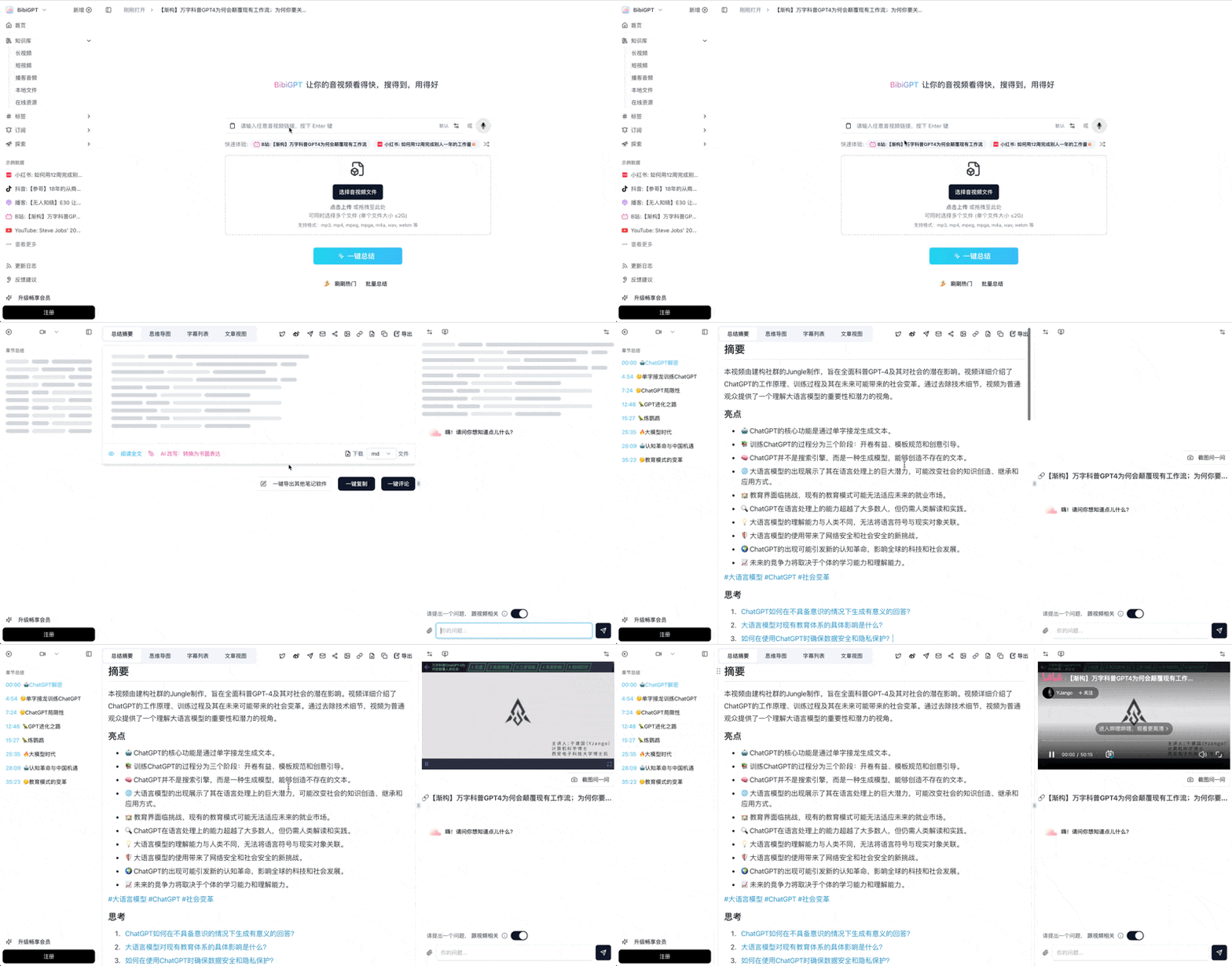
Bilibili: GPT-4 & Workflow Revolution
A deep-dive explainer on how GPT-4 transforms work, covering model internals, training stages, and the societal shift ahead.
Want to summarize your own videos?
BibiGPT supports YouTube, Bilibili, TikTok and 30+ platforms with one-click AI summaries
Try BibiGPT FreePodsqueeze: The Content Factory for Podcast Creators
Podsqueeze serves podcast creators rather than listeners. It transforms long episodes into show notes, timestamps, social media posts, blog articles, and newsletter drafts — all at a cost of roughly $1-2 per episode.
Key Strengths:
- Creator-focused output: One-click generation of show notes, blog posts, social clips, and newsletters
- High cost efficiency: Among the lowest per-episode costs in the market
- Auto timestamps: Listeners can jump to specific moments easily
Limitations:
- Designed for content production, not content consumption or learning
- No AI dialogue, follow-up questions, or knowledge management features
- No Chinese podcast platform support
- Output quality is best treated as a first draft that typically needs human editing
Podsqueeze is purpose-built for podcast hosts who need derivative content fast. If you are a listener looking to extract knowledge, it solves a different problem.
NoteGPT: Lightweight Online Summarizer
NoteGPT is a browser-based AI summarizer that accepts podcast URLs or uploaded files and outputs concise notes. Its zero-install, paste-and-go simplicity makes it accessible for occasional use.
Key Strengths:
- Zero-friction start: Paste a URL and get a summary — no download or account setup required
- Multi-content support: Handles podcasts, YouTube videos, and documents
- Clean note-style output: Summaries are formatted for quick reading
Limitations:
- Narrow podcast platform coverage, dependent on URL parsing
- No custom transcription engine options
- Cannot handle batch processing or automatic subscriptions
- Weak knowledge management and note-tool integration
NoteGPT works for occasional one-off podcast summaries, but it cannot sustain a high-frequency podcast learning routine.
BibiGPT: The Only AI Podcast Tool Covering 9 Platforms
BibiGPT is the largest AI audio-video assistant by user base (1M+ users, 5M+ summaries processed). In the podcast category, its core differentiator is the combination of 9-platform coverage + switchable transcription engines + bidirectional video-podcast conversion — a combination no other tool in this comparison offers.
9 Podcast Platforms Supported:
BibiGPT supports direct link pasting and summarization from Apple Podcasts, Spotify, Xiaoyuzhou, Ximalaya, Google Podcasts, Pocket Casts, Overcast, Castro, and ListenNotes. Whether you are a global English podcast power listener or a Chinese podcast enthusiast, there is no need to switch tools.
Custom Transcription Engines:
Transcription accuracy is the foundation of summary quality. BibiGPT lets you switch between Whisper and ElevenLabs Scribe — Whisper for general multilingual content, Scribe for higher accuracy on English domain-specific terminology. This is the only tool in the comparison that gives users engine-level control.
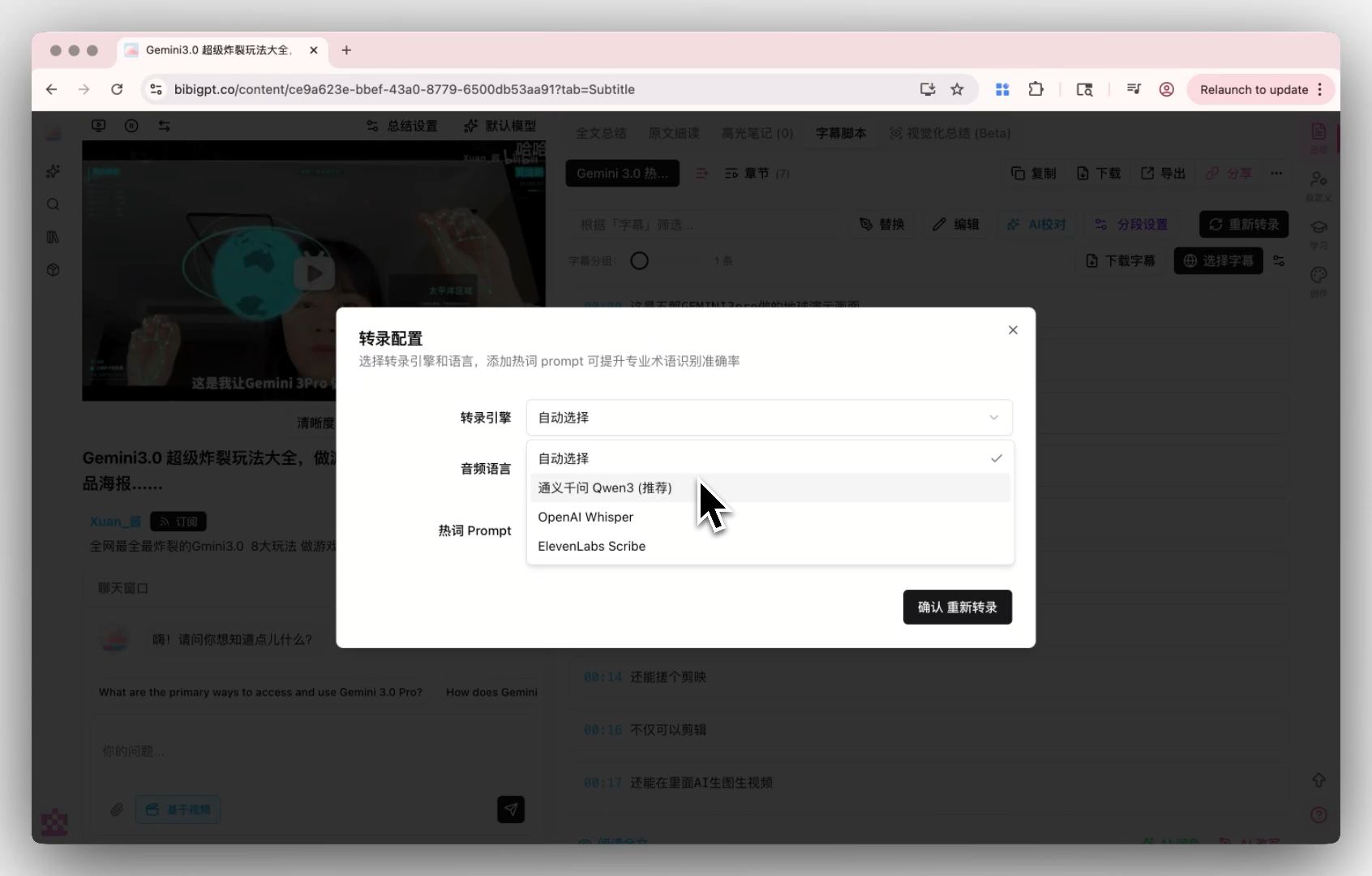 Custom transcription engine
Video-to-Podcast Conversion:
BibiGPT's video-to-podcast feature converts any video into MP3/OGG dual-host podcast audio in one click — so video courses and talks become commute-friendly audio content.
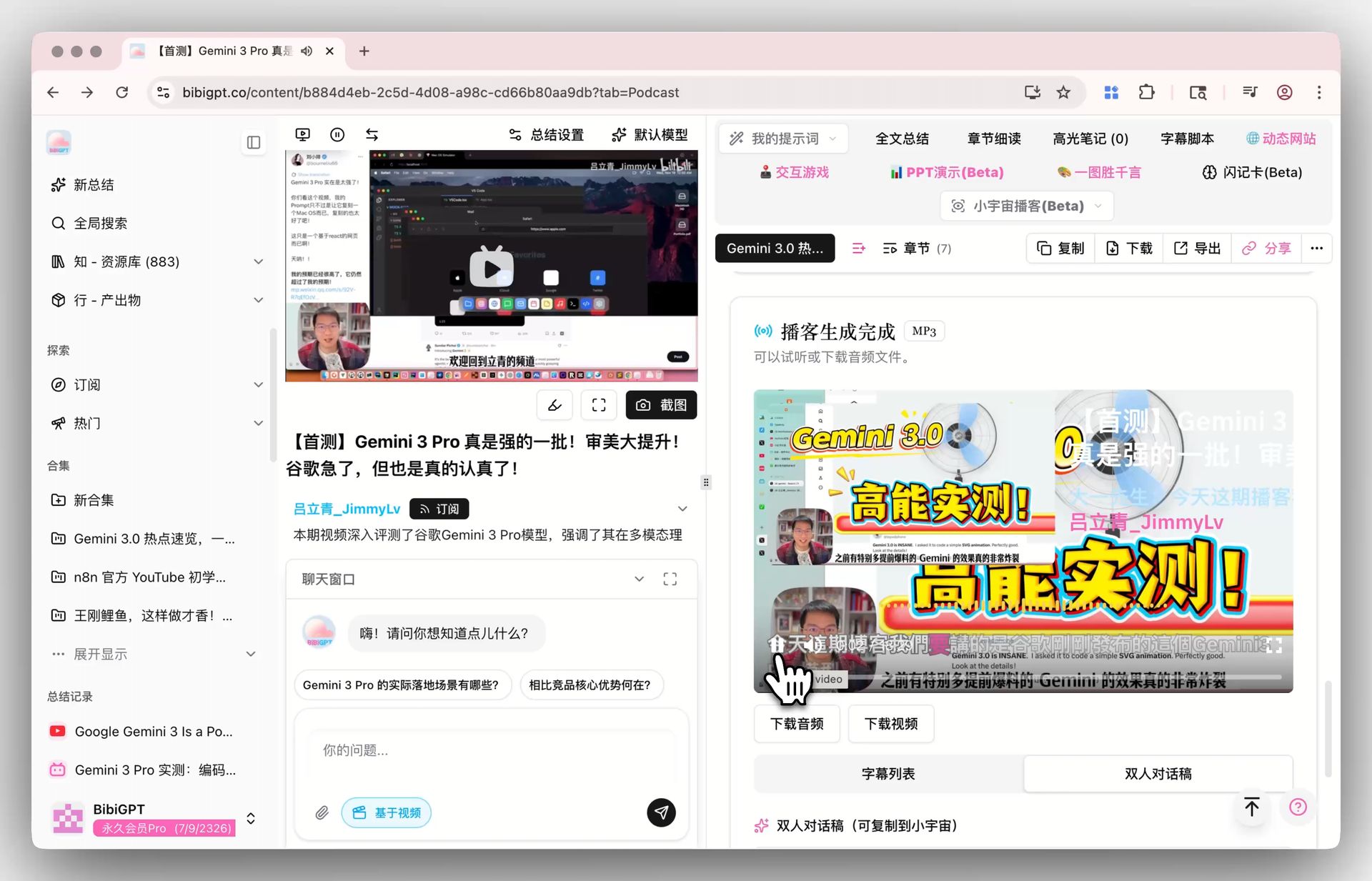 Video to podcast
Complete Learning Loop:
- AI Podcast Summary: Structured summaries + mind maps + flashcards for deep comprehension
- Podcast to Article: Convert podcast content into blog posts and articles with one click
- Podcast Transcript Generator: Full-text transcription with sentence-level timestamps
- AI follow-up dialogue with source tracing: Ask questions about the episode and get answers with clickable timestamps
- Auto-translate on upload: Pre-set a target language and get automatic translation during transcription
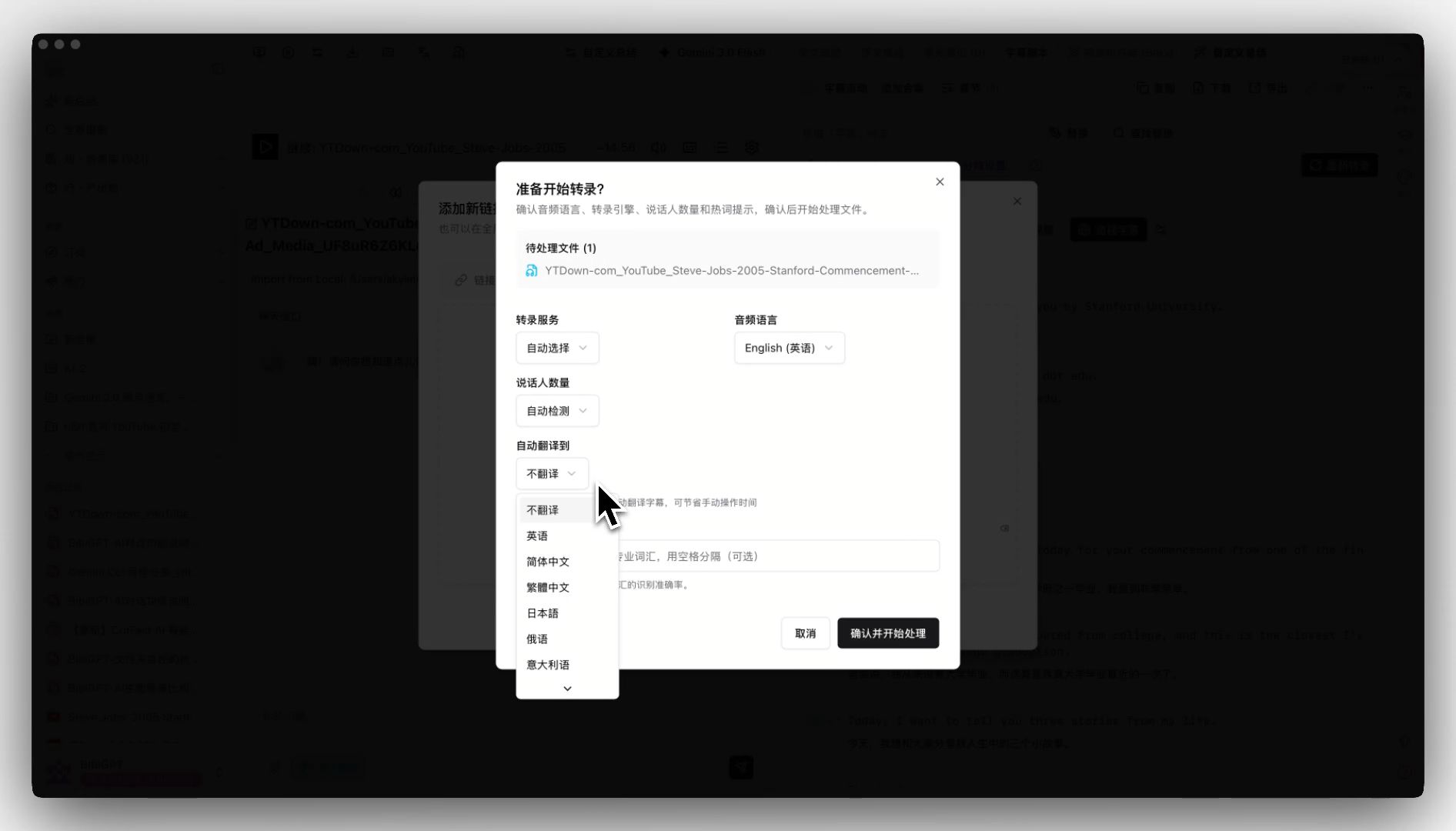 Auto translate on upload
How to Choose the Right AI Podcast Tool for You
The decision framework is straightforward: start with platform coverage, then evaluate summary depth and workflow integration. Here are scenario-based recommendations:
- Cross-platform power learners (multilingual, audio + video mixed) → BibiGPT — the only solution covering 9 podcast platforms plus 30+ video platforms
- Academic researchers (deep analysis of select sources) → NotebookLM — strongest citation tracing and conversational AI
- English-only RSS subscribers (automated podcast workflows) → Podwise — auto-sync and structured output
- Mobile commuters (highlight-based listening) → Snipd — best-in-class highlight and pre-listen experience
- Podcast hosts (need derivative content fast) → Podsqueeze — lowest cost per episode for content repurposing
Frequently Asked Questions
Q: How accurate is AI podcast transcription in 2026?
Mainstream transcription engines now achieve average word error rates (WER) between 5% and 8%. The newly open-sourced Cohere Transcribe model hit 5.42% WER on the Hugging Face Open ASR Leaderboard. BibiGPT's dual-engine approach (Whisper + ElevenLabs Scribe) lets users pick the best engine for each use case, with reported accuracy improvements of 10-15% on domain-specific content compared to single-engine tools.
Q: What if I listen to Chinese podcasts on Xiaoyuzhou or Ximalaya?
Currently, BibiGPT is the only tool in this comparison that supports direct link summarization from Xiaoyuzhou and Ximalaya. All other tools require you to download the audio file first and upload it manually.
Q: Can I turn video courses into podcasts?
Yes. BibiGPT's video-to-podcast conversion transforms YouTube, Bilibili, and other video content into MP3/OGG podcast audio with dual-host narration — perfect for converting video lectures into commute-friendly listening material.
Conclusion
The AI podcast transcription and summary landscape in 2026 is more competitive than ever, with open-source models like Cohere Transcribe continuing to lower the technology floor. But for end users, the real question is not "which model has the lowest WER" — it is which tool covers the platforms you actually use and fits into the workflow you already have. If your podcast library spans multiple platforms and languages, BibiGPT's 9-platform coverage, switchable transcription engines, and video-podcast bidirectional conversion make it the most complete solution available today.
Experience BibiGPT now
Ready to try these powerful features? Visit BibiGPT and start your intelligent audio/video summarization journey!
Get startedStart your AI-powered podcast learning journey with BibiGPT:
🌐 Web App: aitodo.co 📱 Mobile App: iOS / Android 🖥️ Desktop Client: macOS / Windows ✨ Explore All Features